


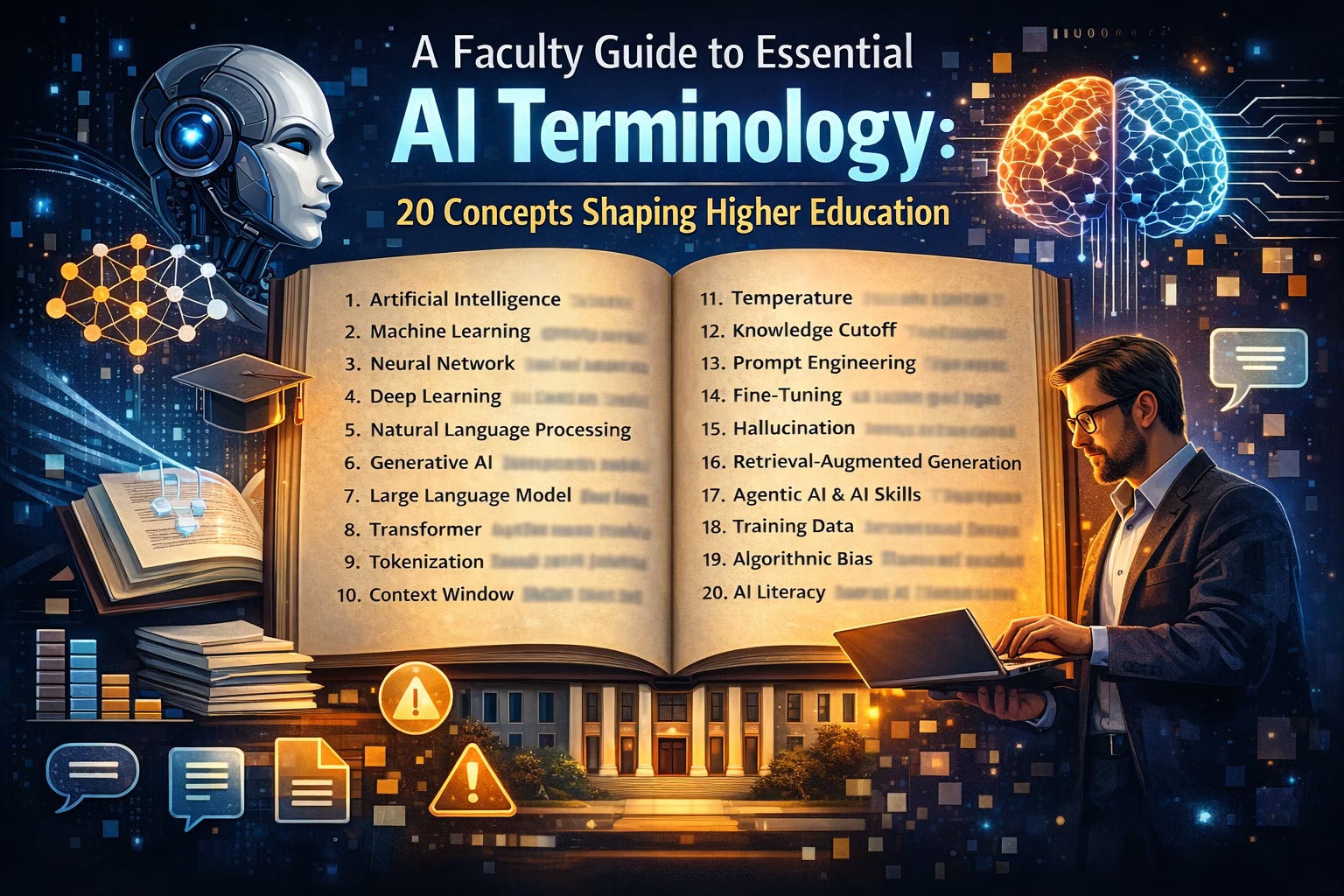
As artificial intelligence (AI) continues to reshape our world, its presence in higher education is no longer a futuristic concept but a present-day reality. Faculty members are increasingly encountering AI in their research, in their teaching, and in the work their students produce. While many are familiar with tools like ChatGPT, a deeper understanding of the core concepts driving this technology is essential for navigating this new landscape effectively and responsibly.
This guide is designed for you, the intelligent academic. It provides clear, accessible definitions for 20 key AI terms, with a focus on their relevance to your work. Our goal is to move beyond the buzzwords and equip you with the foundational knowledge needed to engage critically and creatively with AI in your professional life.
Part 1: Foundational Concepts
Understanding the following terms is the first step to grasping how AI systems function.
1. Artificial Intelligence (AI)
At its core, Artificial Intelligence refers to machine-based systems designed to perform tasks that would otherwise require human intelligence.1 This is a broad, umbrella term that encompasses everything from the algorithms that recommend books on Amazon to the complex systems that can compose music or diagnose diseases.
2. Machine Learning (ML)
Machine Learning is a critical subset of AI. Instead of being explicitly programmed with rules for every possible scenario, ML algorithms are “trained” on large datasets. By analyzing this data, they learn to identify patterns and make predictions or decisions on their own.2 For faculty, this is the technology behind many research tools that analyze large datasets and educational platforms that personalize learning paths for students.
3. Neural Network
Inspired by the structure of the human brain, a Neural Network is a type of computing system composed of interconnected nodes, or “neurons,” organized in layers. As data passes through these layers, the network processes it, allowing it to recognize complex patterns in data like images, sounds, and text.3
4. Deep Learning
Deep Learning is an advanced form of machine learning that uses neural networks with many layers (hence, “deep”). This multi-layered structure enables deep learning models to achieve a much more sophisticated level of pattern recognition than standard machine learning models. It is the driving force behind many of the most impressive AI applications, including advanced image recognition and natural language translation.4
Part 2: The Language of AI
This group of terms relates to the AI that has captured the public imagination—systems that can understand and create human-like content.
5. Natural Language Processing (NLP)
Natural Language Processing is the field of AI that gives computers the ability to understand, interpret, and generate human language—both text and speech. NLP is the technology that powers everything from grammar-checking software and automated transcription services to the chatbots you interact with online.5
6. Generative AI (GenAI)
Generative AI refers to a class of AI models that can create new, original content. This isn’t limited to text; GenAI can produce images, music, computer code, and videos. These models are trained on vast amounts of existing data and learn the underlying patterns and structures to generate novel outputs . For academics, this has profound implications for everything from creating course materials to generating hypotheses for research.6
7. Large Language Model (LLM)
A Large Language Model is the foundational technology behind text-based generative AI tools like ChatGPT, Claude, and Gemini. An LLM is a massive neural network trained on an enormous corpus of text and data. Its primary function is to predict the next word in a sequence, allowing it to generate coherent, contextually relevant, and often surprisingly human-like text.7
8. Transformer
The Transformer is a specific neural network architecture that has revolutionized natural language processing and made modern LLMs possible (it’s the “T” in GPT, which stands for Generative Pre-trained Transformer). Its key innovation is a mechanism called “self-attention,” which allows the model to weigh the importance of different words in a text, enabling it to grasp context and nuance far more effectively than previous models.8
Part 3: The Mechanics of LLMs
These concepts explain how LLMs process information and how their behavior can be fine-tuned.
9. Tokenization
Before an LLM can process text, it must first break it down into smaller pieces through Tokenization. These pieces, called tokens, can be words, parts of words, or even individual characters. For example, the word “unhappiness” might be tokenized into “un,” “happi,” and “ness.” This process allows the model to handle a vast vocabulary and understand grammatical structures. The number of tokens in a prompt and its response is also a key metric for how AI services are priced.9
10. Context Window
The Context Window is the amount of information (measured in tokens) that an LLM can process at one time. It is, in essence, the model’s short-term memory. Everything within the context window—including the initial prompt, any documents provided, and the preceding conversation—is considered by the model when it generates a response. Early models had small context windows (around 2,000 tokens), but newer models can handle millions of tokens, equivalent to thousands of pages of text, enabling the analysis of entire books or extensive research papers in a single prompt.10
11. Temperature
Temperature is a parameter that controls the randomness of an LLM’s output. A low temperature (e.g., 0.2) makes the model more deterministic and focused, causing it to select the most likely next token. This is ideal for factual recall or summarization. A high temperature (e.g., 0.9) increases randomness, allowing the model to choose less likely tokens, which can lead to more creative, novel, or diverse responses. For academic work, adjusting temperature allows you to control the trade-off between precision and creativity.11
12. Knowledge Cutoff
The Knowledge Cutoff is the specific point in time beyond which an AI model has not been trained on new data. For example, a model with a knowledge cutoff of April 2023 will have no inherent information about events, discoveries, or publications that occurred after that date. This is a critical limitation for academics to understand, as it means an LLM’s baseline knowledge is never fully current. While some models can now access the live internet to supplement their knowledge, their core training data remains fixed in time.12
Part 4: Practical Applications and Critical Considerations
This final set of terms is crucial for using AI effectively and ethically in an academic setting.
13. Prompt Engineering
Prompt Engineering is the art and science of crafting effective inputs (prompts) to guide a generative AI model toward a desired output. A well-designed prompt can be the difference between a generic, unhelpful response and a nuanced, insightful one. For faculty and students alike, developing prompt engineering skills is becoming essential for leveraging AI tools successfully in research and learning.13
14. Fine-Tuning
Fine-Tuning is the process of taking a general, pre-trained model and training it further on a smaller, specialized dataset. This adapts the model to a specific domain or task. For example, a faculty member could fine-tune an LLM on a collection of historical documents to make it an expert on that period, or on their own writing to have it adopt their specific style. This process allows for the creation of highly specialized AI tools without the prohibitive cost of training a model from scratch.14
15. Hallucination
An AI hallucination is a phenomenon where an LLM generates a response that is plausible-sounding but is factually incorrect, nonsensical, or not based on its training data. This can include fabricating quotes, making up historical events, or, most critically for academics, inventing citations to non-existent articles.15 Recognizing the potential for hallucination is a cornerstone of responsible AI use.
16. Retrieval-Augmented Generation (RAG)
Retrieval-Augmented Generation is a technique designed to combat hallucinations and improve the accuracy of LLMs. A RAG system connects an LLM to an external, authoritative knowledge base (such as a library database or a specific set of research papers). Before generating a response, the model “retrieves” relevant information from this trusted source, grounding its output in verifiable facts.16
17. Agentic AI & AI Skills
Agentic AI represents a significant step beyond simple chatbots. These are autonomous AI systems capable of planning and executing multi-step tasks to achieve a goal with minimal human intervention. An AI agent might be tasked with conducting a literature review by searching databases, summarizing papers, and compiling a report. These agents are often equipped with AI Skills—modular capabilities or tools (like web browsing, code execution, or file access) that allow them to perform a wide range of actions to complete their objectives.17-18
18. Training Data
Training Data is the vast collection of information—text, images, code—used to train an AI model. The quality, diversity, and source of this data are critically important, as they directly shape the model’s capabilities, knowledge, and inherent biases.19
19. Algorithmic Bias
Algorithmic Bias refers to systematic and repeatable errors in an AI system that result in unfair outcomes, often disadvantaging certain population groups. This bias typically originates from the training data, which may reflect existing societal prejudices, or from flawed model design. In an academic context, this is a major concern for AI-powered tools used in admissions, proctoring, and even grading.20
20. AI Literacy
Finally, AI Literacy is the set of competencies that enables individuals to understand and critically evaluate AI, communicate and collaborate with it, and use it as a tool for learning and problem-solving. As AI becomes more integrated into our personal and professional lives, fostering AI literacy among both faculty and students is becoming a fundamental responsibility of higher education.21
References
[1] National Education Association. (2025, June 20). AI Glossary of Terms.
[2] IBM. (n.d. ). What is Machine Learning?.
[3] IBM. (n.d. ). What are Neural Networks?.
[4] IBM. (n.d. ). What is Deep Learning?.
[5] IBM. (n.d. ). What is Natural Language Processing?.
[6] McKinsey & Company. (2023, January 26 ). What is generative AI?.
[7] CIRCLS. (2024, March 31 ). Glossary of Artificial Intelligence Terms for Educators.
[8] Vaswani, A., et al. (2017 ). Attention Is All You Need. arXiv:1706.03762.
[9] NVIDIA. (2025, March 17). Explaining Tokens — the Language and Currency of AI.
[10] McKinsey & Company. (2024, December 5 ). What is a context window for Large Language Models?.
[11] Vellum. (n.d. ). LLM Temperature: How It Works and When You Should Use It.
[12] Wikipedia. (n.d. ). Knowledge cutoff.
[13] IBM. (n.d. ). What is Prompt Engineering?.
[14] IBM. (n.d. ). What is Fine-Tuning?.
[15] IBM. (n.d. ). What are AI Hallucinations?.
[16] IBM. (n.d. ). What is Retrieval-Augmented Generation (RAG)?.
[18] Inference. (2026, February 2 ). Agent Skills: The Open Standard for AI Capabilities.
[19] CIRCLS. (2024, March 31 ). Glossary of Artificial Intelligence Terms for Educators.
[20] National Education Association. (2025, June 20 ). AI Glossary of Terms.