


Introduction
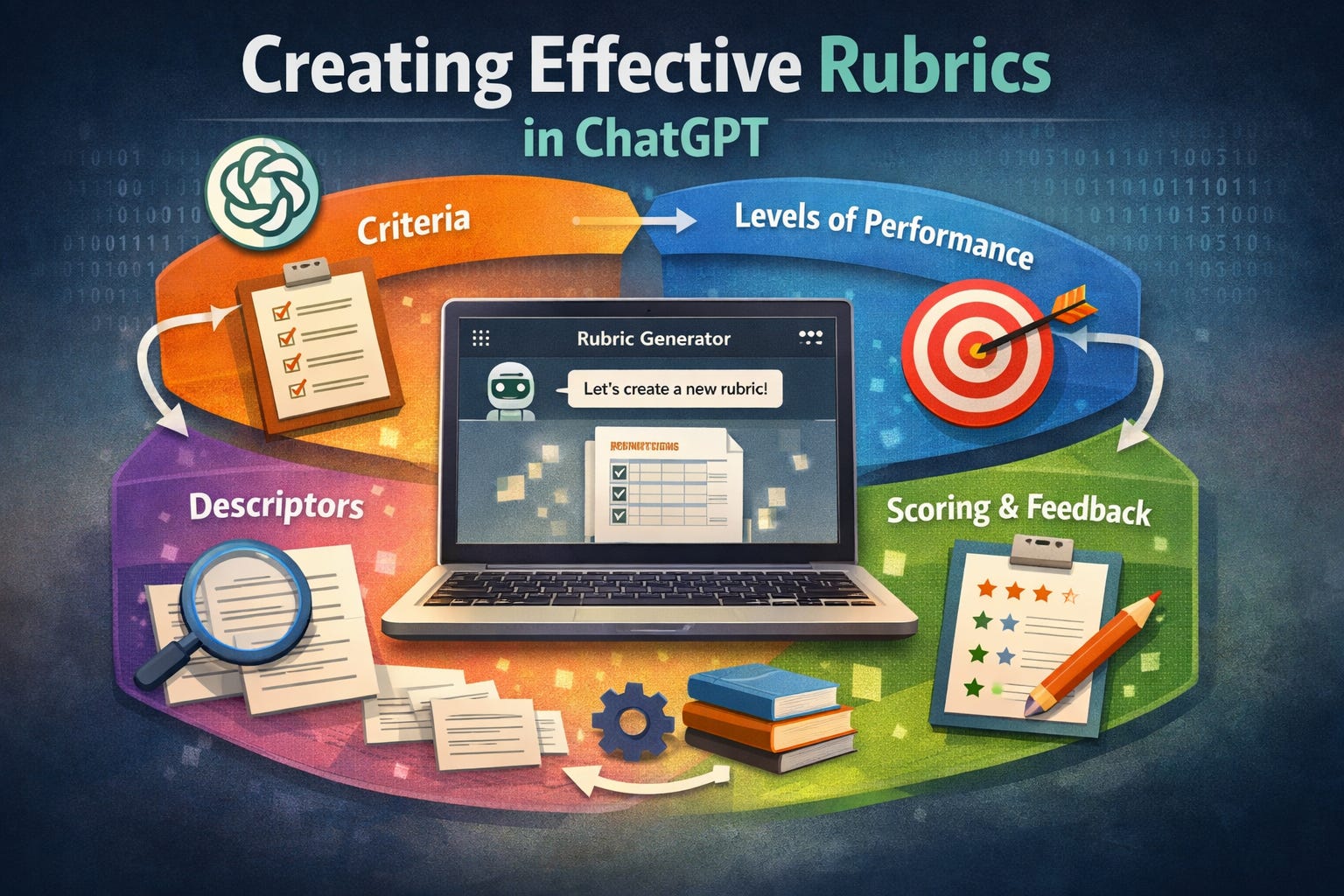
Crafting a high-quality rubric stands as a cornerstone of effective assessment, offering students a clear roadmap to success while equipping faculty with a consistent evaluation framework. Yet, the process of building a truly effective rubric—one that is detailed, aligned with learning outcomes, and articulated in student-friendly language—demands a significant investment of time and intellectual energy. It is in this context that generative artificial intelligence, and specifically ChatGPT, emerges as a powerful collaborative partner in our work.
This guide is designed for faculty—particularly those who may be new to using large language models—to provide a structured, step-by-step process for leveraging ChatGPT to create customized, high-quality rubrics. We will move from the foundational work of gathering materials to the practical steps of creating an account, crafting effective prompts, and refining the AI-generated output. The objective is not to replace the pedagogical expertise of the instructor, but to augment it, transforming a time-consuming task into an efficient and collaborative process.
By the end of this guide, you will be equipped to confidently use ChatGPT as an instructional design assistant, capable of generating a strong first draft of a rubric that you can then refine to perfectly suit your course, your assignment, and your students.
Chapter 1: What You Need to Begin: The Foundation of a Good Rubric
Before engaging with the technology, we must ground our work in sound pedagogical practice. The quality of any AI-generated output is directly proportional to the quality of the input. This principle holds especially true when creating assessment tools. To build an effective rubric with ChatGPT, you must first provide it with the necessary context and materials.
Think of this initial phase as preparing a detailed brief for an instructional design assistant. The more thorough and clear your instructions are, the more useful the final product will be. Before you write your first prompt, take a moment to gather the following essential documents:
The Full Assignment Description
This is the most critical piece of the puzzle. You must provide ChatGPT with the exact prompt, instructions, formatting requirements, and any contextual information you provide to your students. The AI needs to understand the task from the student’s perspective to create relevant evaluation criteria. An incomplete or paraphrased assignment description will lead to a generic and misaligned rubric. Take the time to copy and paste the entire, verbatim text of the assignment.
Associated Learning Outcomes
Next, identify the specific course or module learning objectives that the assignment is designed to measure. Are you assessing critical analysis, data interpretation, persuasive writing, or technical skill? Explicitly stating these outcomes (e.g., “Upon completing this assignment, students will be able to analyze primary source documents within their historical context”) ensures the rubric is a valid and aligned assessment of student learning. This step connects the assignment directly to your broader course goals and forces the AI to prioritize criteria that reflect those goals.
A Preliminary List of Key Assessment Criteria
You are the subject matter expert. Before you even open ChatGPT, you have an intuitive or explicit sense of what constitutes a successful submission. Jot down a preliminary list of the core components you intend to evaluate. This could include elements like “Thesis Statement Clarity,” “Methodological Rigor,” “Use of Evidence,” “Critical Analysis,” “Organization,” or “Presentation Skills.” This initial list, born from your own expertise, will serve as the backbone of your rubric and provide a starting point for the AI to build upon.
Having these materials on hand will not only streamline the process of prompting the AI but will also ensure that the resulting rubric is a meaningful and accurate tool for assessing student work.