


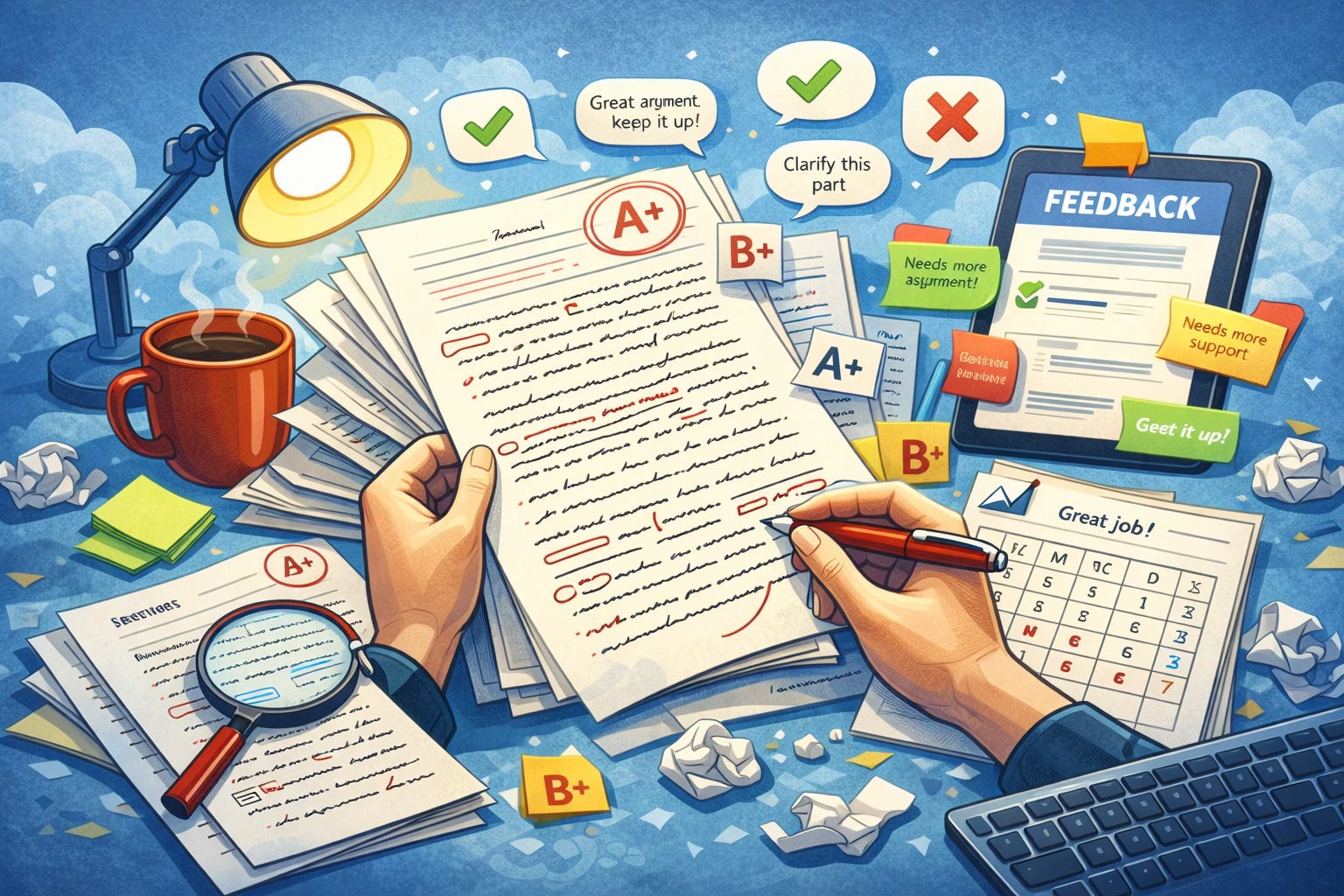
For generations of educators, the red pen has been a symbol of our commitment to student growth. We spend countless hours poring over student work, offering corrections, and providing guidance. While this process is fundamental to learning, it is also incredibly time-consuming. The challenge of providing timely, detailed, and personalized feedback to every student is a familiar struggle. The emergence of artificial intelligence, however, presents a paradigm shift in how we approach this essential task. AI-powered tools are not here to replace the thoughtful, nuanced feedback that only a human educator can provide, but to augment our abilities, freeing us to focus on the higher-order aspects of learning.
The Promise of AI-Powered Feedback
The most significant advantage of using AI for student feedback is the ability to provide immediate and scalable responses. Research has consistently shown that timely feedback is crucial for student learning. When students receive feedback while their work is still fresh in their minds, they are more likely to engage with it and apply it to their revisions. AI tools can provide this instant feedback on a scale that is simply not possible for a single educator. This immediacy can transform the writing process from a linear progression of drafts into a dynamic cycle of writing, feedback, and revision.
AI can also help to address the more mechanical aspects of writing, such as grammar, syntax, and citation formatting. By automating feedback on these lower-order concerns, AI tools free up educators to concentrate on the more complex and critical aspects of student work, such as the strength of their arguments, the clarity of their thinking, and the creativity of their ideas.
A Glimpse into the AI-Powered Classroom
A number of innovative tools are already making their way into classrooms. Tools like Brisk Teaching, a Chrome extension that integrates with Google Docs, and MagicSchool.ai, which allows educators to create a customized space for their students, are empowering both teachers and learners. These platforms can be tailored with specific rubrics and assignment guidelines to provide targeted feedback that aligns with the learning objectives of a particular task. The feedback is often broken down into strengths, areas for growth, and even questions to prompt further reflection, creating a more interactive and personalized experience for the student.
The Irreplaceable Human Element
Despite the remarkable capabilities of AI, it is essential to recognize its limitations. AI algorithms, no matter how sophisticated, lack the contextual understanding, empathy, and personal knowledge of a human educator. They cannot fully appreciate a student’s individual voice, their unique struggles, or the creative risks they may be taking. Furthermore, AI models are not infallible. They can be prone to biases present in their training data and may even generate inaccurate or nonsensical feedback—a phenomenon often referred to as a “hallucination.” Therefore, it is crucial that students are taught to approach AI-generated feedback with a critical eye and to ultimately make their own informed decisions about their writing.
Best Practices for Integrating AI into Your Feedback Workflow
To harness the power of AI effectively and ethically, educators should adopt a thoughtful and strategic approach to its implementation:
Curate and Customize: Before introducing any AI tool to your students, take the time to test it yourself. Experiment with different prompts and settings to understand its capabilities and limitations. Customize the tool with your own rubrics and instructional materials.
Teach Critical Engagement: Explicitly teach your students how to use AI tools responsibly and critically. Encourage them to view AI-generated feedback as a starting point for a conversation, not as a definitive judgment of their work.
Foster Dialogue: Use AI-generated feedback as a catalyst for deeper conversations about writing. Encourage students to reflect on the feedback they receive and to articulate how they plan to use it to improve their work.
The Future of Feedback
The integration of AI into the feedback process is not about replacing the art of teaching with the science of algorithms. It is about using technology to enhance our ability to do what we do best: to guide, to mentor, and to inspire our students. By embracing AI as a powerful assistant, we can save valuable time, provide more immediate and personalized feedback, and ultimately, empower our students to become more confident and capable writers. The future of feedback is not a choice between the red pen and the algorithm, but a partnership between the two, with the educator firmly at the helm.