



The rapid advancement of artificial intelligence has sparked both excitement and apprehension across the academic landscape. For qualitative researchers, the prospect of using AI to analyze complex, nuanced data is a compelling, yet controversial, proposition. Can an algorithm truly grasp the subtleties of human experience? Or does the integration of AI into our work risk sacrificing the very depth and rigor that defines qualitative inquiry? This post explores the rise of the “Centaur Researcher”—a model that combines the analytical power of AI with the irreplaceable interpretive skills of the human mind. We will examine the practical applications, ethical considerations, and the future of AI in qualitative data analysis.
The State of the Art: What AI Can (and Can’t ) Do
It is crucial to approach AI not as a replacement for the researcher, but as a sophisticated assistant. Large Language Models (LLMs) like ChatGPT and Gemini can process vast amounts of text in seconds, performing tasks that would take a human researcher hours or even days. AI excels at the heavy lifting of qualitative analysis, such as transcribing interviews, organizing data, and performing initial deductive coding based on a predefined codebook . This can free up valuable time for researchers to focus on higher-level analytical tasks.
However, the limitations of AI are as significant as its capabilities. Current AI models lack true understanding and are unable to “read between the lines” of human communication—a hallmark of inductive analysis . They struggle with complex methodologies that require a deep, emergent understanding of the data, such as grounded theory. Furthermore, the risk of AI “hallucinations,” where the model generates plausible but false information, remains a serious concern that necessitates constant vigilance from the researcher .
In contrast, the human researcher brings a unique and irreplaceable set of skills to the analytical process. We possess the contextual understanding, cultural awareness, and ethical judgment necessary to interpret data in a meaningful way. Our ability to build rapport with participants, to understand unspoken cues, and to construct a compelling narrative from disparate data points are all quintessentially human strengths. While we are slower and more prone to certain biases than our AI counterparts, our capacity for deep, interpretive analysis remains unmatched.
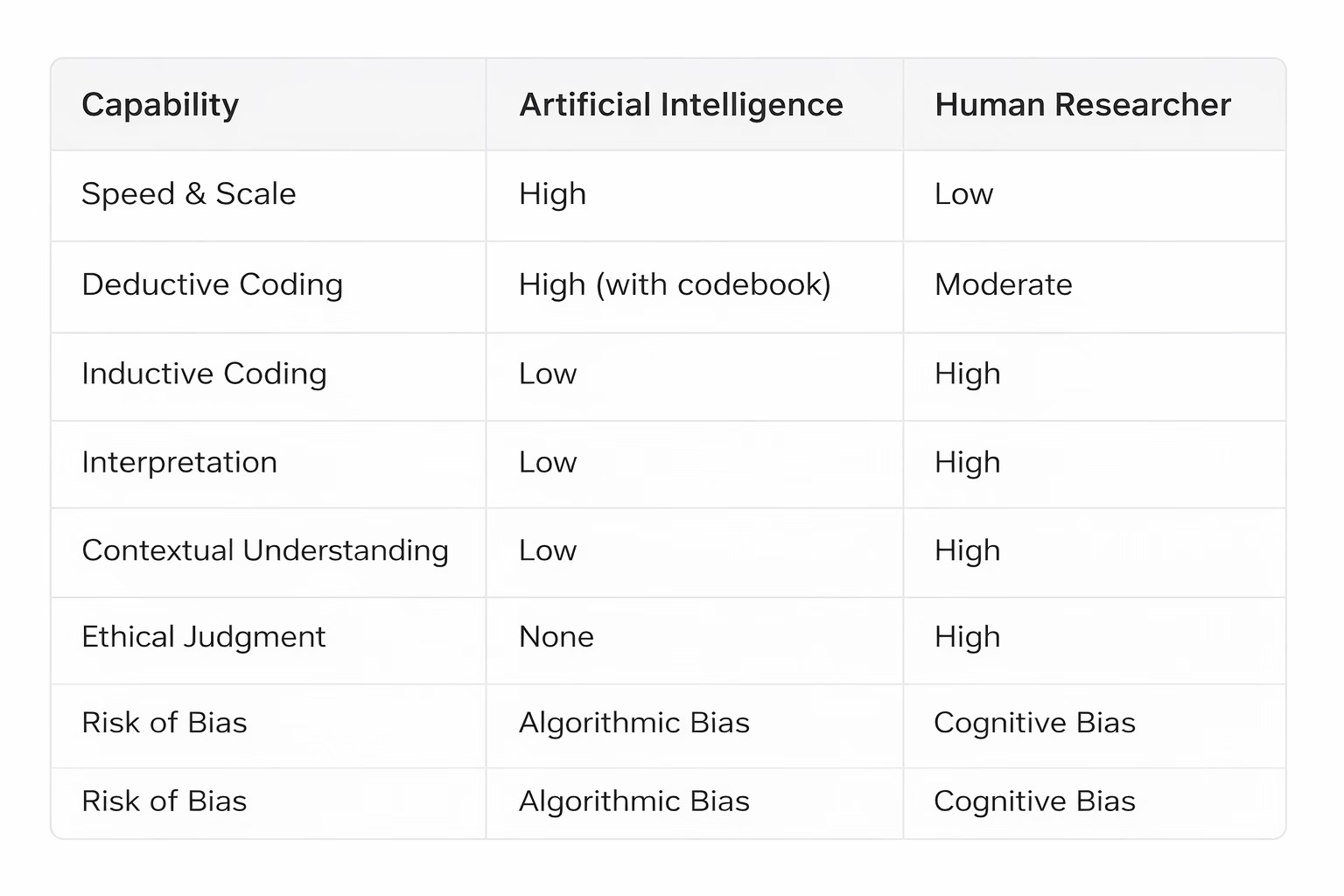
A Framework for AI-Assisted Qualitative Analysis
To effectively integrate AI into the qualitative workflow, we can adopt a phased approach that leverages the strengths of both human and machine intelligence.
Phase 1: Data Preparation & Exploration. In the initial phase, AI can be a powerful ally. Automated transcription services can quickly and accurately convert audio and video recordings into text. Once transcribed, AI tools can be used to perform an initial exploration of the dataset, identifying frequently used terms and suggesting preliminary patterns.
Phase 2: Coding & Categorization. During the coding phase, AI can assist with deductive coding by applying a pre-defined codebook to the dataset. This is particularly useful for large-scale projects where consistency and efficiency are paramount. However, the researcher must maintain oversight, reviewing and refining the AI-generated codes to ensure accuracy. The human researcher remains the final arbiter of the coding process.
Phase 3: Analysis & Interpretation. In the final and most critical phase, the role of the human researcher comes to the forefront. While AI can help identify relationships between codes and generate summaries, it is the researcher who must interpret these findings, develop rich themes, and construct a coherent narrative. This is where the “Centaur Researcher” truly shines, blending the computational power of AI with the deep, interpretive insight of the human mind.
Ethical Considerations
The integration of AI into qualitative research is not without its ethical challenges. The use of cloud-based AI tools raises significant concerns about data privacy and security, particularly when working with sensitive information. Researchers must ensure they are using secure platforms and have obtained appropriate consent from participants. The potential for algorithmic bias to perpetuate or even amplify existing societal inequalities is another critical concern that requires careful consideration.
Looking ahead, the future of AI in qualitative research is likely to be one of collaboration, not replacement. We can expect to see the development of more sophisticated AI tools designed for the needs of qualitative researchers. As these tools become more powerful, it will be incumbent upon the research community to develop new skills and best practices for their ethical and effective use. The enduring value of human-centric qualitative research will not be diminished by AI, but rather enhanced by it.